> ## Documentation Index
> Fetch the complete documentation index at: https://schaltwerk.mintlify.site/llms.txt
> Use this file to discover all available pages before exploring further.
# Agent Setup
> Configure agent binaries, environment variables, setup scripts, and run mode
Configure each agent from **Settings → Agent Configuration** before you launch sessions. Open Settings by clicking the gear icon in the top bar.
> Commands in this guide use `bun`. Swap to npm equivalents (`npm run …`, `npm install`, etc.) if that's your default toolchain.
Settings are saved locally in `~/Library/Application Support/schaltwerk/settings.json` (plain JSON). Keep this file protected if you store API keys.
## Storage Locations
**Location:** `~/Library/Application Support/schaltwerk/settings.json`
**Contains:**
* Agent binaries
* CLI arguments
* Agent-specific environment variables
* Personal defaults
**Location:** `~/Library/Application Support/schaltwerk//database.db`
**Contains:**
* Worktree setup scripts
* Project environment variables
* Run scripts
* Session state
Changes only apply after you click **Save** in the bottom-right corner of the Settings modal.
## Choose the Agent Binary
Choose from: GitHub Copilot, Claude Code, OpenCode, Codex, Gemini, Kilo Code, Qwen, Factory Droid, Amp, or Terminal
* Select a detected binary from the dropdown
* Or paste an absolute path for custom builds
* For Terminal mode: No binary required (uses system shell)
Schaltwerk shows:
* Installation method
* Version number
* Full path to executable
### Terminal-Only Mode
Terminal mode opens a session with just your default system shell - no AI agent is started automatically.
**Use Cases:**
* Running custom agents manually
* Custom development workflows
* Testing commands in isolated worktrees
* Manual code exploration
**How It Works:**
* Creates an isolated Git worktree (same as other sessions)
* Opens top terminal with your default shell (`$SHELL`)
* No agent binary required
* Initial prompt is not pasted automatically
* Environment variables and setup scripts still apply
**Configuration:**
* **Binary:** None required (Terminal uses system shell)
* **CLI Arguments:** Not applicable for Terminal mode
* **Environment Variables:** Supported - configure in Settings
* **Setup Scripts:** Supported - runs before terminal opens
Terminal mode is perfect for running agents not yet integrated into Schaltwerk, or for custom development workflows that don't require AI assistance.
### GitHub Copilot CLI
Copilot launches as soon as the top terminal is ready. Install the CLI first, then trust each worktree once so the agent can run unattended.
**Installation:**
```bash theme={null}
npm install -g @github/copilot
```
After installation run `/login` in any Copilot session to authenticate.
**Trust the worktree:** Inside Copilot run `/cwd /trust` (or `/add-dir`) the first time you open a new project. Copilot stores this trust in `~/.config/github-copilot/cli` so future sessions start immediately.
**Automatic prompts:** Schaltwerk queues your initial task prompt and submits it once Copilot finishes booting. If you disable auto-start or see Copilot waiting for input, just hit `Enter` to re-send the command.
### Common Binary Locations
```bash Claude Code (Homebrew) theme={null}
/opt/homebrew/bin/claude
```
```bash Codex (npm global) theme={null}
~/.npm-global/bin/codex
```
```bash Factory Droid theme={null}
~/.local/bin/droid
```
```bash Google Gemini theme={null}
/usr/local/bin/gcloud
```
```bash Qwen Code theme={null}
/usr/local/bin/qwen
```
```bash Custom Build theme={null}
/Users/you/dev/agent-cli/bin/agent
```
Schaltwerk auto-detects common installation paths. If your binary isn't listed, paste the absolute path.
## Add Custom CLI Arguments
Use the **CLI Arguments** field to append extra flags to the launch command.
### Argument Parsing
Arguments are parsed with shell-style quoting:
```bash Profile Selection theme={null}
--profile work
```
```bash Model Override theme={null}
--model gpt-4
```
```bash Sandbox Mode theme={null}
--sandbox danger-full-access
```
```bash Multiple Arguments theme={null}
--profile work --model gpt-4 --verbose
```
Codex launches are normalized automatically (single-dash long flags are fixed and profiles come before `--model`).
### When Arguments Apply
CLI arguments are appended:
* Every time the top terminal starts
* When you trigger a restart from the session toolbar
* After the setup script completes
## Set Agent Environment Variables
Add key/value pairs for the agent terminal (API keys, profile names, feature flags).
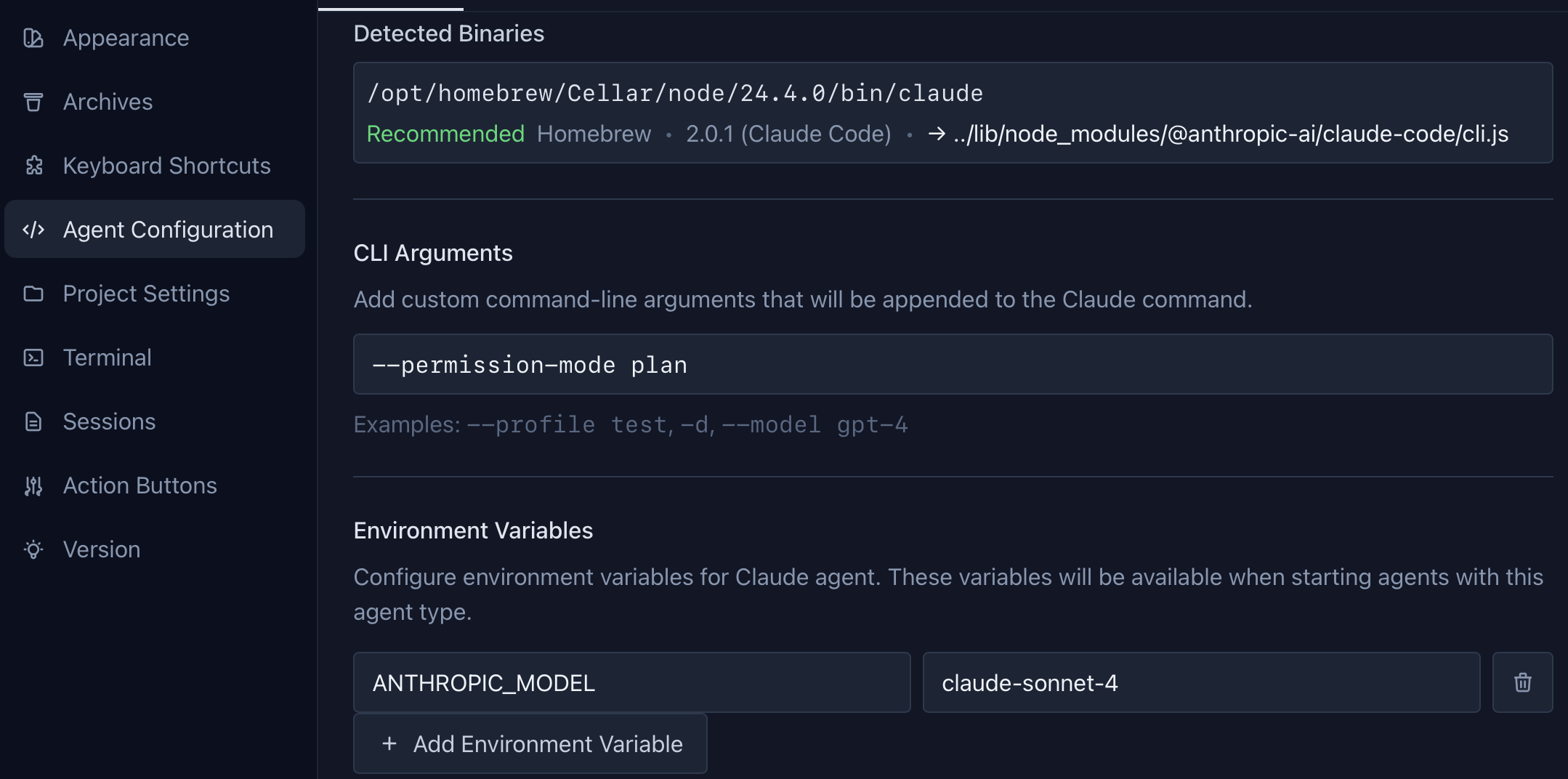 **Key points:**
* Variables are scoped per agent type (Claude Code doesn't see Codex vars, Factory Droid stays isolated)
* Merged with project-level variables at agent start
* Stored unencrypted - rotate keys on shared machines
* Use **Edit variables** button for bulk editing
**Example Variables:**
```bash API Keys theme={null}
OPENAI_API_KEY=sk-...
ANTHROPIC_API_KEY=sk-ant-...
```
```bash Feature Flags theme={null}
ENABLE_EXPERIMENTAL=true
DEBUG_MODE=false
```
```bash Configuration theme={null}
AGENT_PROFILE=production
MODEL_OVERRIDE=gpt-4
```
## Project Defaults
Open **Settings → Run & Environment** to configure shared defaults for every session.
### Worktree Setup Script
Runs once when Schaltwerk creates a new worktree. Perfect for dependency installation, environment setup, and project bootstrapping.
#### Available Environment Variables
```bash Session Variables theme={null}
$WORKTREE_PATH # /path/to/repo/.schaltwerk/worktrees/session-name
$REPO_PATH # /path/to/repo
$SESSION_NAME # session-name
$BRANCH_NAME # schaltwerk/session-name
```
#### Common Setup Tasks
```bash theme={null}
#!/bin/bash
cp "$REPO_PATH/.env.template" "$WORKTREE_PATH/.env"
echo "SESSION_NAME=$SESSION_NAME" >> "$WORKTREE_PATH/.env"
```
```bash theme={null}
#!/bin/bash
cd "$WORKTREE_PATH"
bun install # or: npm install
```
```bash theme={null}
#!/bin/bash
cd "$WORKTREE_PATH"
bun run db:seed
```
```bash theme={null}
#!/bin/bash
mkdir -p "$WORKTREE_PATH/logs"
mkdir -p "$WORKTREE_PATH/tmp"
```
**Execution:**
* Runs in top terminal before agent launches
* Creates `.schaltwerk/setup.done` marker (delete to force re-run)
* Optional - leave empty if not needed
If the setup script fails, the agent won't start. Check the top terminal for errors.
### Project Environment Variables
Added to every agent launch. Perfect for configuration shared by all agents.
**Benefits:** Set once, available everywhere. Agent vars + Project vars = Final environment.
**Example:**
```bash Shared API Keys theme={null}
DATABASE_URL=postgres://localhost/dev
REDIS_URL=redis://localhost:6379
```
```bash Project Configuration theme={null}
NODE_ENV=development
LOG_LEVEL=debug
```
```bash Feature Flags theme={null}
ENABLE_ANALYTICS=false
USE_LOCAL_API=true
```
### Run Script (⌘E)
Define a command to execute with `⌘E` in the bottom terminal.
**Configuration:** Set command (e.g., `bun run dev` / `npm run dev`), optional working directory, optional environment variables.
**Features:** Real-time output, exit status display, press `⌘E` again to stop.
**Common examples:** `bun run dev` / `npm run dev`, `bun run test` / `npm run test`, `bun run build` / `npm run build`, `bun run lint` / `npm run lint`
## Recommended Setup Flow
Using an MCP-capable agent? Have it call `schaltwerk_get_setup_script` first, inspect which untracked config (e.g., `.env`, `.npmrc`) should be copied into worktrees, confirm with you, then send the full script via `schaltwerk_set_setup_script`. In the UI, Schaltwerk will still prompt before saving.
1. Open **Settings → Run & Environment**
2. Add project environment variables
3. Write worktree setup script
4. Define run script for `⌘E`
1. Open **Settings → Agent Configuration**
2. For each agent you use:
* Select binary path
* Add CLI arguments
* Set agent-specific environment variables
1. Create a test spec
2. Start session (`⌘N`)
3. Verify setup script runs successfully
4. Check agent launches with correct configuration
1. Press `⌘E` in bottom terminal
2. Confirm run script executes correctly
3. Check environment variables are present
Once configured, every new session will automatically use these settings!
## Troubleshooting
**Check:**
* Binary path is correct and executable
* Agent has necessary permissions
* CLI arguments are valid
* Environment variables are set correctly
**Debug:**
* Look at top terminal output for error messages
* Try running binary manually from command line
**Check:**
* Script has execute permissions
* All required dependencies are available
* Environment variables are accessible
**Debug:**
* Check top terminal for error output
* Run script manually with same environment
* Verify marker file isn't preventing re-run
**Check:**
* Clicked **Save** in Settings modal
* Variables are set in correct section (agent vs project)
* No typos in variable names
**Debug:**
* Print environment in agent terminal: `env | grep VAR_NAME`
* Check both agent and project variable sections
**Check:**
* Run script is defined in project settings
* Working directory exists
* Command is valid for your project
**Debug:**
* Check bottom terminal for error messages
* Try running command manually in terminal
**Problem:** After upgrading your agent, Schaltwerk still uses the old version
**Cause:** Multiple installations exist, Schaltwerk points to the old binary
**Solution:**
1. Find current installation path: `which `
2. Open **Settings → Agent Configuration**
3. Select the agent tab (Claude Code, Codex, etc.)
4. Click **Refresh Binary** to auto-detect new version
5. Or manually select the correct binary path
6. Return to active sessions and restart the agent
**Note:** Binary paths are cached per agent. Always refresh after system upgrades.
## Security Best Practices
Settings are stored unencrypted. Follow these guidelines to protect sensitive data:
Regularly rotate API keys and tokens
Store sensitive values in system keychain when possible
Limit file permissions on settings.json
Don't store API keys on shared/public machines
## Next Steps
Learn the day-to-day workflow
Master the keyboard shortcuts
**Key points:**
* Variables are scoped per agent type (Claude Code doesn't see Codex vars, Factory Droid stays isolated)
* Merged with project-level variables at agent start
* Stored unencrypted - rotate keys on shared machines
* Use **Edit variables** button for bulk editing
**Example Variables:**
```bash API Keys theme={null}
OPENAI_API_KEY=sk-...
ANTHROPIC_API_KEY=sk-ant-...
```
```bash Feature Flags theme={null}
ENABLE_EXPERIMENTAL=true
DEBUG_MODE=false
```
```bash Configuration theme={null}
AGENT_PROFILE=production
MODEL_OVERRIDE=gpt-4
```
## Project Defaults
Open **Settings → Run & Environment** to configure shared defaults for every session.
### Worktree Setup Script
Runs once when Schaltwerk creates a new worktree. Perfect for dependency installation, environment setup, and project bootstrapping.
#### Available Environment Variables
```bash Session Variables theme={null}
$WORKTREE_PATH # /path/to/repo/.schaltwerk/worktrees/session-name
$REPO_PATH # /path/to/repo
$SESSION_NAME # session-name
$BRANCH_NAME # schaltwerk/session-name
```
#### Common Setup Tasks
```bash theme={null}
#!/bin/bash
cp "$REPO_PATH/.env.template" "$WORKTREE_PATH/.env"
echo "SESSION_NAME=$SESSION_NAME" >> "$WORKTREE_PATH/.env"
```
```bash theme={null}
#!/bin/bash
cd "$WORKTREE_PATH"
bun install # or: npm install
```
```bash theme={null}
#!/bin/bash
cd "$WORKTREE_PATH"
bun run db:seed
```
```bash theme={null}
#!/bin/bash
mkdir -p "$WORKTREE_PATH/logs"
mkdir -p "$WORKTREE_PATH/tmp"
```
**Execution:**
* Runs in top terminal before agent launches
* Creates `.schaltwerk/setup.done` marker (delete to force re-run)
* Optional - leave empty if not needed
If the setup script fails, the agent won't start. Check the top terminal for errors.
### Project Environment Variables
Added to every agent launch. Perfect for configuration shared by all agents.
**Benefits:** Set once, available everywhere. Agent vars + Project vars = Final environment.
**Example:**
```bash Shared API Keys theme={null}
DATABASE_URL=postgres://localhost/dev
REDIS_URL=redis://localhost:6379
```
```bash Project Configuration theme={null}
NODE_ENV=development
LOG_LEVEL=debug
```
```bash Feature Flags theme={null}
ENABLE_ANALYTICS=false
USE_LOCAL_API=true
```
### Run Script (⌘E)
Define a command to execute with `⌘E` in the bottom terminal.
**Configuration:** Set command (e.g., `bun run dev` / `npm run dev`), optional working directory, optional environment variables.
**Features:** Real-time output, exit status display, press `⌘E` again to stop.
**Common examples:** `bun run dev` / `npm run dev`, `bun run test` / `npm run test`, `bun run build` / `npm run build`, `bun run lint` / `npm run lint`
## Recommended Setup Flow
Using an MCP-capable agent? Have it call `schaltwerk_get_setup_script` first, inspect which untracked config (e.g., `.env`, `.npmrc`) should be copied into worktrees, confirm with you, then send the full script via `schaltwerk_set_setup_script`. In the UI, Schaltwerk will still prompt before saving.
1. Open **Settings → Run & Environment**
2. Add project environment variables
3. Write worktree setup script
4. Define run script for `⌘E`
1. Open **Settings → Agent Configuration**
2. For each agent you use:
* Select binary path
* Add CLI arguments
* Set agent-specific environment variables
1. Create a test spec
2. Start session (`⌘N`)
3. Verify setup script runs successfully
4. Check agent launches with correct configuration
1. Press `⌘E` in bottom terminal
2. Confirm run script executes correctly
3. Check environment variables are present
Once configured, every new session will automatically use these settings!
## Troubleshooting
**Check:**
* Binary path is correct and executable
* Agent has necessary permissions
* CLI arguments are valid
* Environment variables are set correctly
**Debug:**
* Look at top terminal output for error messages
* Try running binary manually from command line
**Check:**
* Script has execute permissions
* All required dependencies are available
* Environment variables are accessible
**Debug:**
* Check top terminal for error output
* Run script manually with same environment
* Verify marker file isn't preventing re-run
**Check:**
* Clicked **Save** in Settings modal
* Variables are set in correct section (agent vs project)
* No typos in variable names
**Debug:**
* Print environment in agent terminal: `env | grep VAR_NAME`
* Check both agent and project variable sections
**Check:**
* Run script is defined in project settings
* Working directory exists
* Command is valid for your project
**Debug:**
* Check bottom terminal for error messages
* Try running command manually in terminal
**Problem:** After upgrading your agent, Schaltwerk still uses the old version
**Cause:** Multiple installations exist, Schaltwerk points to the old binary
**Solution:**
1. Find current installation path: `which `
2. Open **Settings → Agent Configuration**
3. Select the agent tab (Claude Code, Codex, etc.)
4. Click **Refresh Binary** to auto-detect new version
5. Or manually select the correct binary path
6. Return to active sessions and restart the agent
**Note:** Binary paths are cached per agent. Always refresh after system upgrades.
## Security Best Practices
Settings are stored unencrypted. Follow these guidelines to protect sensitive data:
Regularly rotate API keys and tokens
Store sensitive values in system keychain when possible
Limit file permissions on settings.json
Don't store API keys on shared/public machines
## Next Steps
Learn the day-to-day workflow
Master the keyboard shortcuts