> ## Documentation Index
> Fetch the complete documentation index at: https://schaltwerk.mintlify.site/llms.txt
> Use this file to discover all available pages before exploring further.
# Using Schaltwerk
> Day-to-day workflow of running agents, reviewing output, and managing sessions
This guide walks through the daily workflow of creating specs, running agents, reviewing their output, and keeping your repository clean.
## First Session Quick Start
Press `⌘1` or click **orchestrator** in sidebar
Press `⌘⇧N` and describe what you want the agent to build
Press `⌘N` to create worktree, branch, and terminals
Top terminal shows agent progress automatically
Run tests in bottom terminal, then press `⌘R` to mark as reviewed
## Learn the Layout
* Tabs for each open project
* Gear icon for Settings
* **Open** button (`⌘⇧O`) to launch the active worktree or orchestrator branch in your editor/terminal
* **Keep-awake** button (coffee icon) to prevent sleep during long sessions—gray (disabled), green (active), amber (auto-paused when idle)
* Orchestrator entry
* Session filters (Specs/Running/Reviewed)
* Quick actions for starting agents or creating specs
* Collapse/expand: click the toggle button or press `⌘\` / `Ctrl+\`
* Terminals and diff/review panels
* Grouped per session
Collapse the sidebar to a compact rail for more terminal space or when using the inline diff viewer. Click the toggle button or press `⌘\`.
The **keep-awake** button (coffee icon in top bar) prevents your machine from sleeping during long-running agent tasks. It shows amber when auto-paused because all sessions are idle.
## Create a Spec
Press `⌘1` to work on the main repo branch
Click **Create Spec** in sidebar footer or press `⌘⇧N`
Fill out the markdown prompt with:
* Requirements
* Test expectations
* Acceptance criteria
Specs stay in the orchestrator until you promote them
* Edit anytime
* Duplicate for variations
Keep specs focused so agents work on small, testable changes.
## Start a Session
Highlight the spec in the sidebar
Click **Start Agent** or press `⌘N`
Schaltwerk creates:
* New git worktree in `.schaltwerk/worktrees//`
* Dedicated branch with project's branch prefix
* Two PTY terminals
* Configured worktree setup script runs once
* When complete, top terminal launches your agent
* Agent receives the spec content as initial prompt
The session moves to the **Running** filter and opens two terminals the first time you view it.
## Run Your Agent
**Agent Process**
* Streams the agent process automatically
* Use **Restart** action to reload with new prompt/config
* Agent receives spec content as initial instructions
**Your Shell**
* Regular shell rooted in session worktree
* Use for tests, formatting, helper scripts
* Shows **Run** button when project run script configured
* Press `⌘E` to execute run script
### Run Mode
Configure a run script via **Settings → Run & Environment → Run Script** (e.g., `bun run dev` or `npm run dev`). Then press `⌘E` to launch it—no retyping needed. This lets you quickly verify each agent's changes: `⌘E` → manually test → `⌘E` to stop → switch sessions → repeat.
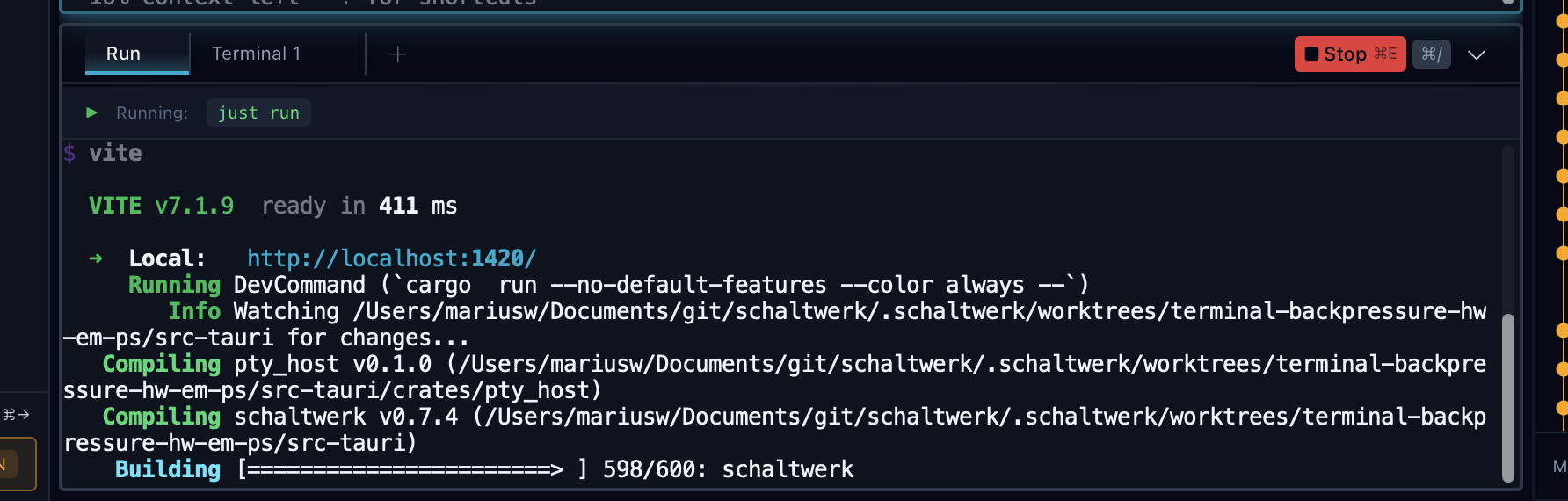 If your app uses fixed ports, consider dynamic port allocation (e.g., `PORT=0`) so multiple sessions can run dev servers simultaneously without conflicts.
### Web Preview
When your run script starts a dev server, click the localhost URL in the terminal to open Schaltwerk's built-in [Web Preview](/guides/web-preview). The preview panel displays your site directly in the app—no browser switching needed. Use the element picker to inspect UI and send HTML snippets to the agent for feedback.
See the full [Web Preview guide](/guides/web-preview) for URL formats, zoom controls, and element picker details.
## Review the Work
* `⌘1–9` to jump to specific session
* `⌘↑/⌘↓` to cycle through sessions
* Terminals stay alive when you change focus
* Press `⌘G` to open the diff viewer
* Toggle **Open diffs inline** to review in sidebar
* Add comments and send to agent with `⌘Enter`
* Execute test suite in bottom terminal
* Or use Run Mode (`⌘E`)
* Verify before marking as reviewed
* Click **Open** (`⌘⇧O`) in top bar
* Launches the session worktree (or orchestrator branch) in your chosen app
* Make manual edits or finish tricky changes alongside the agent
### Inline Diff Review
Enable **Open diffs inline** in the Changes tab to review without leaving your terminals:
If your app uses fixed ports, consider dynamic port allocation (e.g., `PORT=0`) so multiple sessions can run dev servers simultaneously without conflicts.
### Web Preview
When your run script starts a dev server, click the localhost URL in the terminal to open Schaltwerk's built-in [Web Preview](/guides/web-preview). The preview panel displays your site directly in the app—no browser switching needed. Use the element picker to inspect UI and send HTML snippets to the agent for feedback.
See the full [Web Preview guide](/guides/web-preview) for URL formats, zoom controls, and element picker details.
## Review the Work
* `⌘1–9` to jump to specific session
* `⌘↑/⌘↓` to cycle through sessions
* Terminals stay alive when you change focus
* Press `⌘G` to open the diff viewer
* Toggle **Open diffs inline** to review in sidebar
* Add comments and send to agent with `⌘Enter`
* Execute test suite in bottom terminal
* Or use Run Mode (`⌘E`)
* Verify before marking as reviewed
* Click **Open** (`⌘⇧O`) in top bar
* Launches the session worktree (or orchestrator branch) in your chosen app
* Make manual edits or finish tricky changes alongside the agent
### Inline Diff Review
Enable **Open diffs inline** in the Changes tab to review without leaving your terminals:
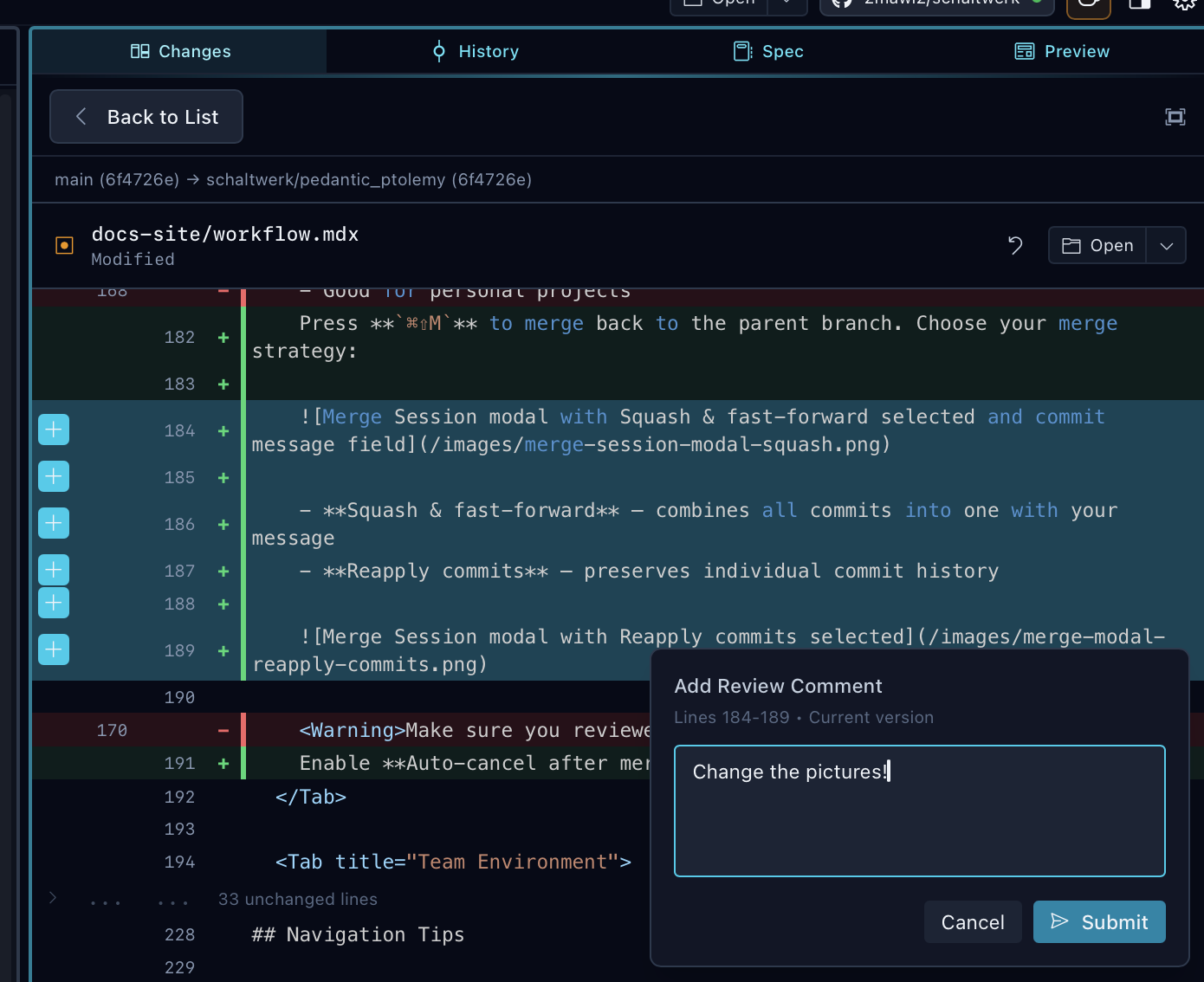
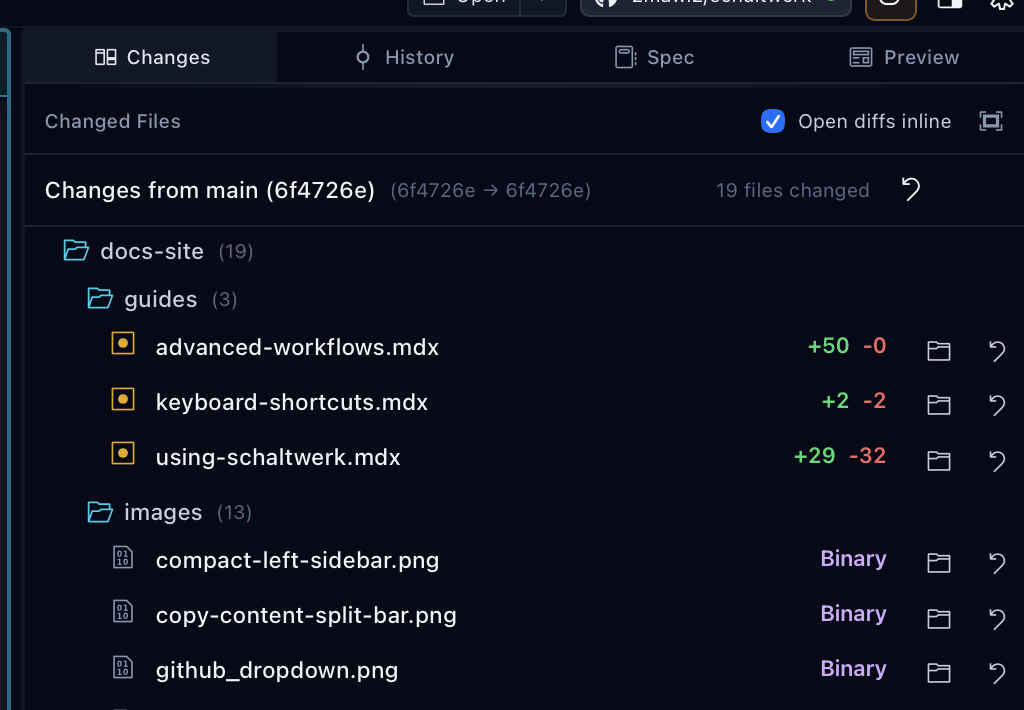 Click a file to view its diff inline. Select lines to add review comments, then click **Finish Review** to send all feedback to the agent:
 ## Copy Context for External AI
Use the **Copy Context** bar to bundle session content for pasting into external AI tools—useful for code reviews, debugging tricky problems with web-based research agents, or leveraging models not available via CLI.
## Copy Context for External AI
Use the **Copy Context** bar to bundle session content for pasting into external AI tools—useful for code reviews, debugging tricky problems with web-based research agents, or leveraging models not available via CLI.
 * **Spec** — include the session's spec/prompt
* **Diff** — include unified diffs of changed files
* **Files** — include full file contents
Select what to include, check the token estimate, and click **Copy Context** to copy to clipboard.
## Mark as Reviewed (Optional)
Marking as reviewed is optional—you can merge or create PRs directly from running sessions.
Run your project's test suite in the bottom terminal
Press `⌘R` or click the checkmark action
Session badge turns green and appears in **Reviewed** filter
From session header actions:
* Create GitHub pull request (`⌘⇧P`)
* Merge directly (`⌘⇧M`)
* Continue editing in external editor
## Convert Back to a Spec
Need to scrap a run but keep the notes?
```bash Keyboard Shortcut theme={null}
⌘S
```
**What happens:**
* Worktree is removed (all uncommitted changes are lost)
* Session branch is deleted from `.schaltwerk/worktrees`
* Markdown spec is preserved
* Session returns to **Specs** filter
* Can be restarted later as a fresh session
Treat the Specs column like a sprint backlog: park exploratory ideas there, restart them with `⌘N`, or scrap a run with `⌘S`—discarding the worktree while keeping the spec ready for another attempt.
Perfect for deferring work or archiving exploratory sessions.
## Merge and Clean Up
Press `⌘⇧M` to merge directly or `⌘⇧P` to create a PR. Works from both running and reviewed sessions.
Press `⌘D` or click **Cancel Session** (or enable **Auto-cancel after merge**)
* Worktree is removed from `.schaltwerk/worktrees/`
* Terminals are closed
* Session disappears from sidebar
You can always recreate from:
* The spec (if preserved)
* Git history (if branch still exists)
Schaltwerk never cancels sessions automatically, so it's safe to keep a branch around while you validate changes.
Need the complete PR workflow (PR context import, PR linking, review-comment tools, branch conflict rules)? See [Pull Requests](/guides/pull-requests).
Master the keyboard shortcuts to speed up your workflow. See the complete [Keyboard Shortcuts](/guides/keyboard-shortcuts) reference.
## Tips for Smooth Sessions
Keep specs focused on small, testable changes that agents can complete confidently
Use separate sessions for competing implementations and pick the best result
The orchestrator can coordinate multiple agents in parallel while you monitor progress
Visit [Agent Setup](/guides/agent-setup) to tweak binaries, environment variables, or project setup scripts
## Common Workflows
1. Create spec describing the bug and expected behavior
2. Start session and let agent investigate
3. Review proposed fix and run tests
4. Mark as reviewed and create PR
1. Draft detailed spec with requirements and acceptance criteria
2. Start session with focused scope
3. Agent implements feature in isolated worktree
4. Test locally in bottom terminal
5. Review, adjust, and merge when ready
1. Create spec outlining refactoring goals
2. Start session on dedicated branch
3. Agent performs refactoring
4. Verify tests still pass
5. Review changes carefully before merging
1. Create spec for experimental approach
2. Start multiple sessions with different strategies
3. Compare results across sessions
4. Keep the best approach, convert the rest back to specs with `⌘S` (discarding their worktrees) or cancel entirely
* **Spec** — include the session's spec/prompt
* **Diff** — include unified diffs of changed files
* **Files** — include full file contents
Select what to include, check the token estimate, and click **Copy Context** to copy to clipboard.
## Mark as Reviewed (Optional)
Marking as reviewed is optional—you can merge or create PRs directly from running sessions.
Run your project's test suite in the bottom terminal
Press `⌘R` or click the checkmark action
Session badge turns green and appears in **Reviewed** filter
From session header actions:
* Create GitHub pull request (`⌘⇧P`)
* Merge directly (`⌘⇧M`)
* Continue editing in external editor
## Convert Back to a Spec
Need to scrap a run but keep the notes?
```bash Keyboard Shortcut theme={null}
⌘S
```
**What happens:**
* Worktree is removed (all uncommitted changes are lost)
* Session branch is deleted from `.schaltwerk/worktrees`
* Markdown spec is preserved
* Session returns to **Specs** filter
* Can be restarted later as a fresh session
Treat the Specs column like a sprint backlog: park exploratory ideas there, restart them with `⌘N`, or scrap a run with `⌘S`—discarding the worktree while keeping the spec ready for another attempt.
Perfect for deferring work or archiving exploratory sessions.
## Merge and Clean Up
Press `⌘⇧M` to merge directly or `⌘⇧P` to create a PR. Works from both running and reviewed sessions.
Press `⌘D` or click **Cancel Session** (or enable **Auto-cancel after merge**)
* Worktree is removed from `.schaltwerk/worktrees/`
* Terminals are closed
* Session disappears from sidebar
You can always recreate from:
* The spec (if preserved)
* Git history (if branch still exists)
Schaltwerk never cancels sessions automatically, so it's safe to keep a branch around while you validate changes.
Need the complete PR workflow (PR context import, PR linking, review-comment tools, branch conflict rules)? See [Pull Requests](/guides/pull-requests).
Master the keyboard shortcuts to speed up your workflow. See the complete [Keyboard Shortcuts](/guides/keyboard-shortcuts) reference.
## Tips for Smooth Sessions
Keep specs focused on small, testable changes that agents can complete confidently
Use separate sessions for competing implementations and pick the best result
The orchestrator can coordinate multiple agents in parallel while you monitor progress
Visit [Agent Setup](/guides/agent-setup) to tweak binaries, environment variables, or project setup scripts
## Common Workflows
1. Create spec describing the bug and expected behavior
2. Start session and let agent investigate
3. Review proposed fix and run tests
4. Mark as reviewed and create PR
1. Draft detailed spec with requirements and acceptance criteria
2. Start session with focused scope
3. Agent implements feature in isolated worktree
4. Test locally in bottom terminal
5. Review, adjust, and merge when ready
1. Create spec outlining refactoring goals
2. Start session on dedicated branch
3. Agent performs refactoring
4. Verify tests still pass
5. Review changes carefully before merging
1. Create spec for experimental approach
2. Start multiple sessions with different strategies
3. Compare results across sessions
4. Keep the best approach, convert the rest back to specs with `⌘S` (discarding their worktrees) or cancel entirely